
OECMs and their effective means of conservation
8 janvier 2026
The origin of Other Effective Conservation Measures (OECMs)
Supporting the international effort to achieve the target of protecting 30 per cent of the world’s land and water by 2030, a new concept has entered the world of conservation internationally and in Québec: other effective area-based conservation measures, or OECMs for short.
Distinct from protected areas, which play a central role in biodiversity conservation, OECMs are a complementary part of the conservation toolkit. They broaden our conception of conservation insofar as they can take a variety of forms ranging from regional parks to exceptional geological sites and from university forests used for research purposes to heritage sites, to name a few. In fact, many sites are already managed in ways that contribute to conserving biodiversity, without being designated as protected areas. On what basis do we recognize that a site is being managed in ways that are effective enough to guarantee its long-term contribution to biodiversity conservation? This is the question we will explore in this article.
What qualifies as an effective conservation measure?
In contrast with protected areas, the official recognition of a site as an OECM is not synonymous with legal protection. Nor does it require conservation to be a primary management objective, although the site must achieve positive outcomes for biodiversity conservation. An OECM can be a site managed for the purposes of research, education, or even economic activity, provided that the mechanisms in place ensure long-term in situ conservation of biodiversity.
So how can we determine whether a site is contributing effectively to biodiversity conservation?
The guidelines for recognizing other effective conservation measures within continental
Québec indicate that the assessment of a site’s eligibility for recognition as an OECM must be “based on the management resources and practices that have already been adopted. OECMs must establish a direct correlation between their area’s management and biodiversity outcomes, with resources available to address current or anticipated threats while preventing adverse long-term effects on biodiversity.”
Therefore, when we refer to effective measures, we are talking about any legal, regulatory, or other means or mechanism that in some way ensures biodiversity conservation within the site, especially by regulating activities that may have a negative impact on it. These means can take many forms, such as agreements, management plans, regional planning tools, or any other mechanism that contributes to conservation efforts. Most often, we are actually looking at a combination of different types of measures. And here the concept of “long-term” refers, in the case of private lands, to a period of at least 25 years, with a view to permanent conservation of the site, and to permanent conservation in the case of public lands.
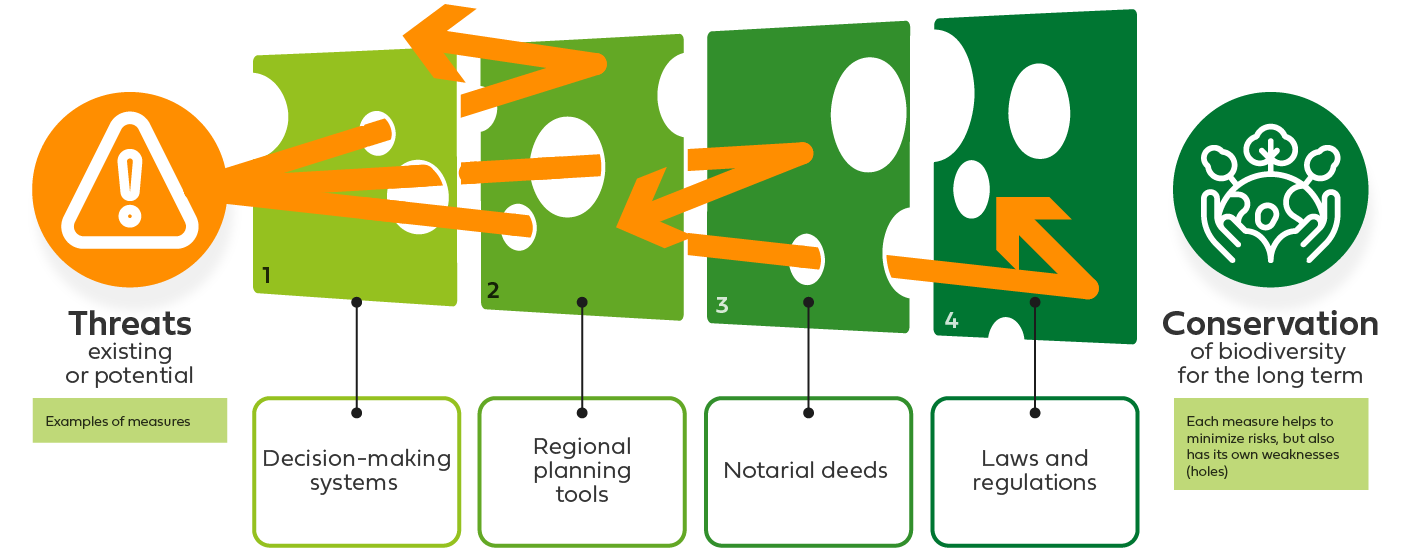
Each of these measures provides protection against threats, but each has its weaknesses. So, while there is no single perfect measure, a combination of measures significantly reduces the risks of biodiversity loss.
To help clarify this approach, we can use the “Swiss cheese” model, which illustrates how implemented measures can mitigate certain threats.
Swiss cheese” model illustrating mechanisms that can contribute to biodiversity conservation efforts



An example by way of illustration
Let’s imagine a fictional forest belonging to a university. This forest is used to conduct research on the effects of climate change on migration patterns of various species, and it is home to a rich biodiversity.
We want to know whether the current site management practices can effectively conserve this biodiversity. And more importantly, can we reasonably expect this aim to be maintained over the long term?
To answer these questions, we need to identify the potential threats to this forest and the biodiversity that depends on it. For example, could the university eventually decide to change the way it is used? Or could a developer see a business opportunity and seek to purchase the land to build a real estate development? In these situations, would it be possible to ensure biodiversity conservation?
The answer depends largely on the management mechanisms already established at the site.
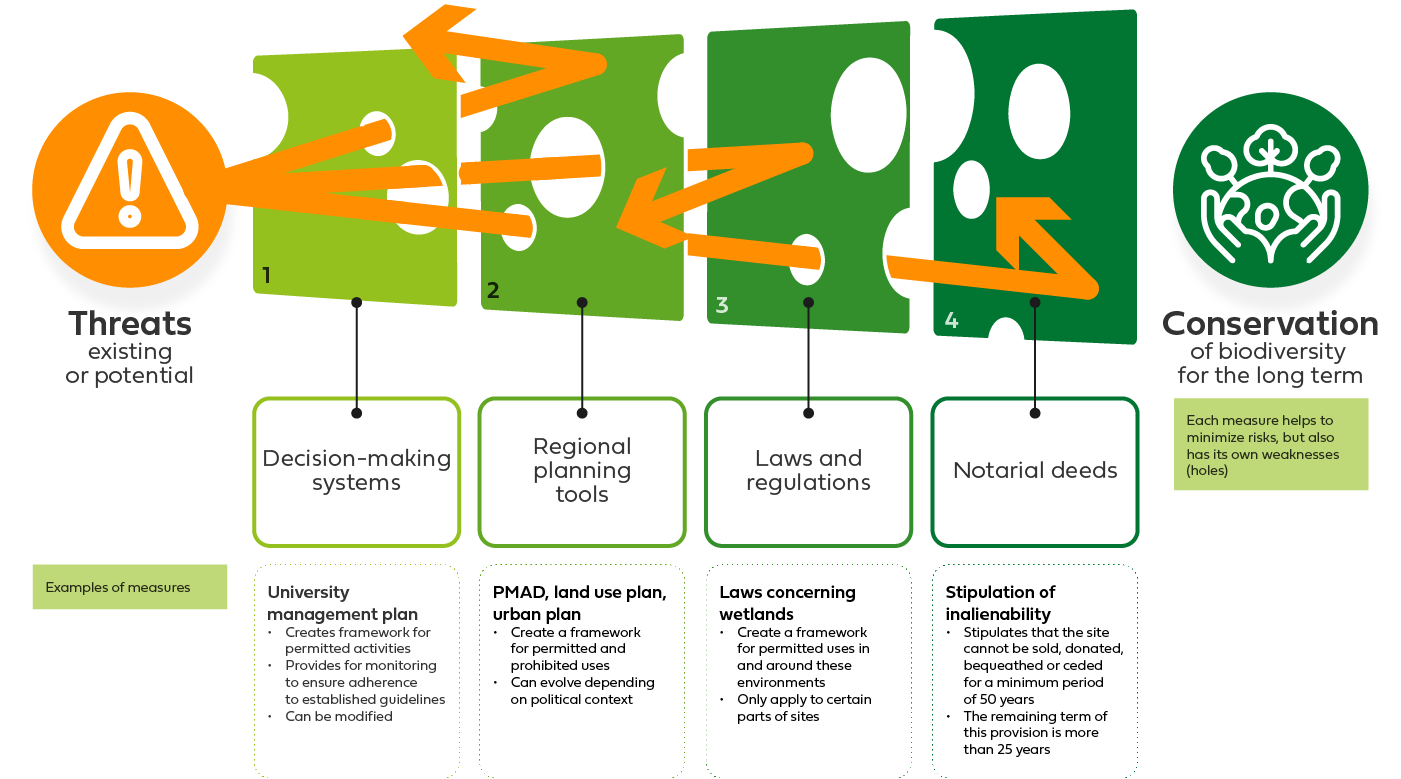
In our fictional scenario, the university has already adopted a management plan for regulating and overseeing permitted activities in the forest. This plan only allows research to be conducted as part of long-term studies, and the methods used must contribute to maintaining or even improving the site’s existing biodiversity. The management plan also provides for year-round monitoring and tracking of the condition of the forest to ensure compliance with the established guidelines. Given its mission of research and knowledge transfer, it is reasonable to believe that the university intends to maintain the forest’s scientific research vocation on a permanent basis.
Located on the outskirts of Quebec City, our fictional forest is also covered by the Plan métropolitain d’aménagement et de développement (PMAD) de la Communauté métropolitaine de Québec, which flags it as a natural environment of conservation interest. At the Regional County Municipality (RCM) level this gets expressed as a conservation area designation in the land use plan, and, at the municipal level, as a conservation zone in the urban plan. These various mechanisms recognize the fragility of the natural environment and provide a framework for what uses can and cannot be made of the area. In our example, scientific research is permitted. However, these planning tools are subject to change depending on the political context.
Let’s also assume that the forest is home to wetlands. These are governed by a specific legal framework under several laws, including the Environment Quality Act and the Act to affirm the collective nature of water resources and to promote better governance of water and associated environments, which regulate the activities that may take place there. However, since wetlands constitute only a part of the forest area, and since, in some cases, activities leading to the degradation or destruction of wetlands may still be allowed, this measure alone does not guarantee the long-term conservation of the site’s overall biodiversity.
Finally, this forest was bequeathed to the university by a forward-thinking family committed to protecting natural environments. In the notarial deed of gift, the family added a special provision, a stipulation of inalienability, which specifies that the land cannot be sold, given away, bequeathed, or transferred for a minimum period of 50 years. The university must therefore remain the owner of the forest for at least this period. In our fictional example, the remaining term of this clause is 35 years.
Taken together, these mechanisms (management plan, regional planning tools, applicable laws, and gift clause) create a demonstrable framework for maintaining biodiversity conservation in the long term. If the university decided to seek to have its research forest recognized as an OECM, it would likely be granted this official recognition by the Ministère de l’Environnement, de la Lutte contre les changements climatiques, de la Faune et des Parcs. The ministry would then issue a certificate officially recognizing the university’s contribution to Québec’s biodiversity conservation efforts!
In the case of other sites, the effective mechanisms could be completely different and just as relevant to obtaining OECM recognition. There are many possible combinations, which is what makes OECMs so attractive: they recognize a variety of stakeholders who contribute to biodiversity conservation, each in their own way. Recognizing their efforts is a step toward inclusive conservation grounded in local realities.
In sum, effective management in OECMs varies from site to site depending on the particular context. However, it generally depends on proven and documented conservation results, long-term management measures, and proper monitoring.
Would you like to see a real-life example of an officially recognized OECM in Québec? Keep an eye on the toolbox on our OECM: Conservation Done Differently, where fact sheets will soon be available!
To learn more about how Nature Québec can provide assistance in the OECM recognition process, visit our information webpage.
Partners
Nature Québec would like to thank Environment and Climate Change Canada and the Ministère de l’Environnement, de la Lutte contre les changements climatiques, de la Faune et des Parcs for their financial support of the OECM project.


Author
Marie-Michèle Doyon, Biodiversity Project Manager
Révision
Chloé Allard, Communications Officer
Marianne Caouette, Biodiversity Project Manager
Simon L’Allier, Biodiversity Project Manager
Emmanuelle Vallières-Léveillé, Director of Biodiversity and Forestry
Marie-Audrey Nadeau-Fortin, Biodiversity Analyst